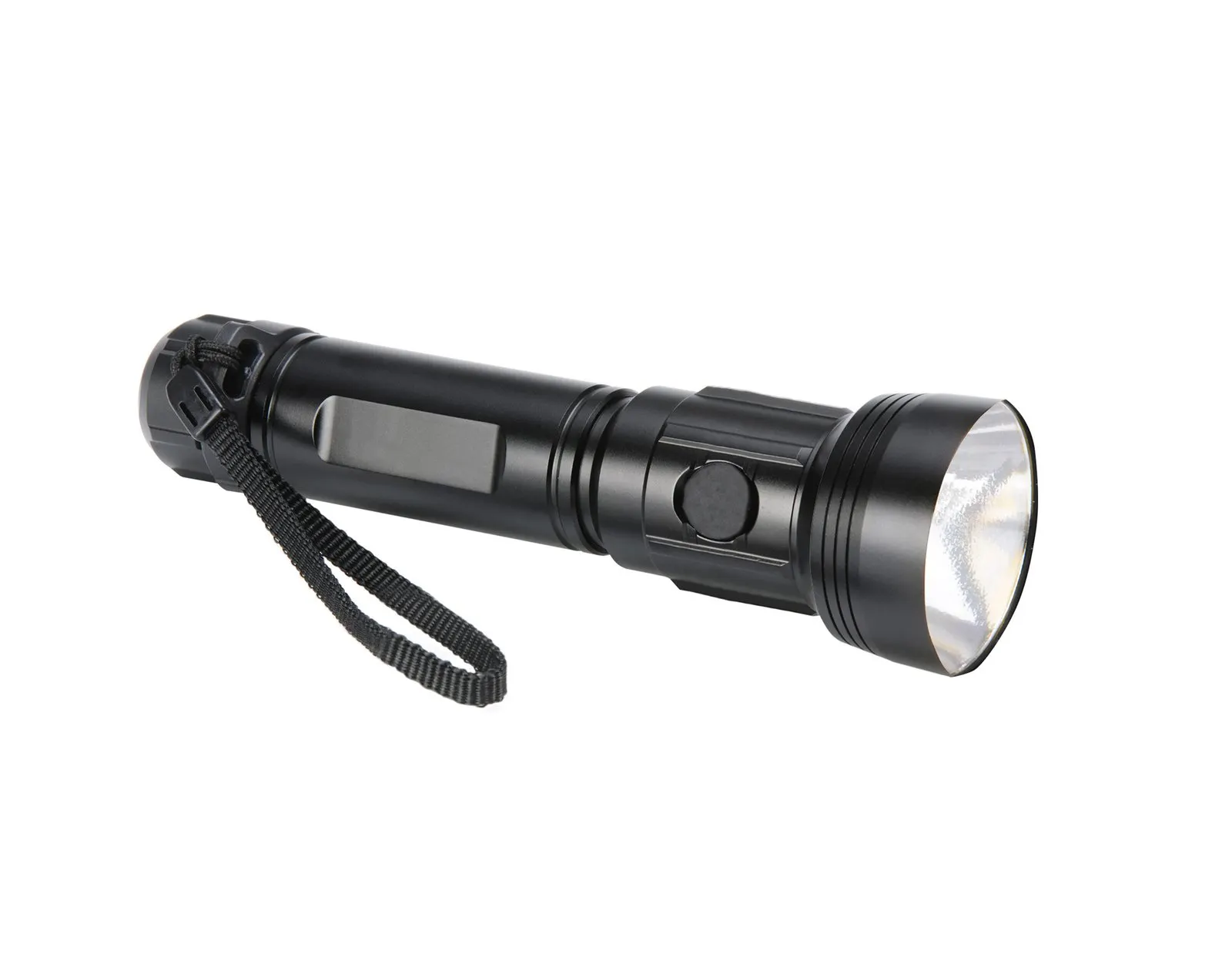
The light everybody wants.
The transformer down the street blows at dinner and the house goes black. Someone has to check the fuse box, someone has to find the dog, and both kids want a light of their own, preferably the big one. An emergency flashlight is the light you hand over or point across the yard, which is exactly why there is always an argument about who gets it.
If your hands will be busy, the headlamp guide covers the other format.
Why the E35R is the example.
The example here is the Fenix E35R. Fenix lists it at a maximum of 3,100 lumens, with USB-C charging and a 21700 lithium-ion battery in the box. A side switch selects the mode, and a lock function keeps it off in storage.
That 3,100 is the number that wins arguments in the kitchen. It is also a peak under Fenix’s stated conditions. Fenix’s instructions describe the output stepping down as heat builds or battery voltage falls, so the brightest mode is not what you get for the whole stated runtime.
Read one mode at a time.
Give each light one line on the shopping list: the mode you expect to leave on, its stated output, and the runtime listed for that same mode.
The charger is part of the flashlight.
A rechargeable light is only as ready as its last charge. Decide where the cable lives, which power source feeds it when the wall sockets are dead, and when someone checks it. The power bank guide covers one backup source; check the charging requirements of both devices before you pair them.
Confirm the package and the compatible battery against the instructions for the exact revision. A battery that fits in the tube is not automatically a battery Fenix approves for that unit.
What reviewers and owners report.
1Lumen measured output starting above Fenix’s 3,100 lumen claim and below it at 30 seconds, likely from thermal regulation (review). Knivesandtools calls the magnet very strong (review), and one owner moved theirs to a family car’s glovebox as the emergency light (owner post).
Owners also report two problems: one says it switched itself on in a pocket even when locked (owner post), and another found only some USB adapters would charge it (owner post). Fenix asks for a recharge every four months in storage, so mark the calendar.
Learn the lock while there is light.
Read the current instructions for the lock, charging and storage. Fenix warns about heat and accidental activation in enclosed spaces, so lock it before it goes into a bag. A flashlight left on in a backpack can build up heat and drain its battery. The socks do not need a reading light.
If it rides in a pack, make reaching it part of the backpack check instead of letting it sink under everything else. And if the argument at dinner was loud, the honest fix may be a second light, not a brighter one.